The evolution of Content Management Systems (CMS) has accelerated dramatically over the past few years, driven by the demand for omnichannel experiences, faster publishing workflows, and more personalized customer interactions. What once served primarily as a website editing tool has now become the backbone of digital operations, powering marketing, commerce, automation, and customer experience initiatives across entire organizations.
As businesses continue to invest in stronger digital ecosystems, several advancements have emerged that fundamentally transform how teams design, deliver, and manage content. Whether your organization works with platforms like Kentico, WordPress, or Optimizely (Episerver), understanding these advancements is essential to building a future-ready digital strategy.
Below is a deep look at the CMS innovations reshaping digital experience today and what these changes mean for organizations aiming to grow, modernize, and stay competitive.
The Shift Toward Headless and Hybrid CMS Architectures
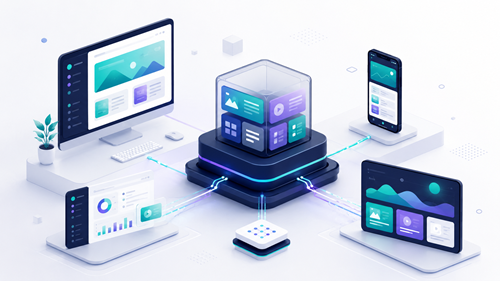
One of the most significant shifts in the industry is the move toward headless and hybrid CMS models. Traditional CMS platforms tightly couple content with its presentation layer, which works well for websites but limits delivery to emerging digital channels. As organizations increasingly need to support mobile apps, kiosks, smart devices, digital signage, and other connected interfaces, headless and hybrid architectures provide the flexibility required.
A headless CMS separates content storage from delivery, allowing teams to reuse content across any channel via APIs. This decoupled model speeds up development, supports omnichannel delivery, and improves consistency across touchpoints. A hybrid CMS, on the other hand, offers the best of both worlds - supporting both traditional page rendering and API-based content delivery. Platforms such as Xperience by Kentico, Optimizely CMS, and modern WordPress headless frameworks have embraced this model, enabling businesses to innovate without sacrificing familiar workflows.
This architectural flexibility ensures organizations can adapt quickly as new channels emerge, making content more accessible, scalable, and future-proof.
Personalization and Customer Experience Optimization
Personalization has become a central driver of effective digital engagement, and modern CMS platforms now offer far more powerful targeting, segmentation, and testing tools than ever before. Instead of treating all website visitors the same, organizations can deliver customized experiences based on user behavior, demographics, preferences, past activity, referral sources, and real-time interactions.
Platforms like Optimizely take personalization even further with experimentation capabilities that allow teams to test variations, measure performance, and continuously refine user experiences. Kentico’s personalization rules allow marketers to dynamically tailor messaging, adjusting content for each audience segment. WordPress sites have also grown more sophisticated through enhanced plugins that support behavioral targeting and dynamic content delivery.
This shift toward experience optimization is not just a trend - it is a response to the growing expectation that brands must deliver relevance. Personalized experiences consistently show higher engagement, increased conversion rates, and stronger long-term customer relationships.
AI-Assisted Content Creation and Workflow Automation
Artificial intelligence is reshaping nearly every aspect of digital operations, and CMS platforms are rapidly integrating AI-driven tools to improve efficiency and content quality. These advancements include predictive content recommendations, automated tagging, natural language generation, intelligent SEO suggestions, and machine-learning-powered workflow optimization.
Content authors benefit from tools that help rewrite, summarize, or expand drafts. Automation enables marketing teams to handle routine tasks such as image optimization, taxonomy updates, and metadata entry more efficiently. Editorial workflows become more efficient with predictive approvals, content scoring, and automated quality checks.
By reducing manual work and improving content accuracy, AI-powered CMS features allow teams to focus more on strategy and creative direction rather than routine production tasks.
Composable Digital Experience Platforms (DXPs)
Another major advancement is the rise of composable DXP architectures. While traditional monolithic systems bundle all functionality into a single platform, composable DXPs enable organizations to build a modular ecosystem by integrating best-in-class tools for content, commerce, analytics, personalization, and customer data.
This approach aligns with the MACH principles (Microservices, API-first, Cloud-native, Headless), providing businesses with unmatched flexibility and scalability. Instead of relying on one oversized system, organizations can assemble exactly what they need and adapt components over time without platform-wide disruptions.
Kentico’s Xperience by Kentico, Optimizely’s DXP, and enterprise WordPress ecosystems all support composable architectures, enabling businesses to modernize incrementally while reducing long-term technical debt.
Improved Security and Compliance Controls
Security is increasingly central to CMS adoption as organizations face more advanced cyber threats and stricter data privacy requirements. Modern CMS platforms now incorporate stronger built-in security features, including multi-factor authentication, fine-grained user permissions, encrypted communication, and routine security updates.
Compliance frameworks such as GDPR, CCPA, and industry-specific regulations are increasingly supported at the platform level through consent tracking, cookie management, and data retention tools. Audit logs, automated monitoring, and version control systems provide greater visibility into content changes and reduce risk associated with multi-user environments.
Strong security and compliance capabilities ensure organizations maintain trust while protecting both their brand and customer data.
Cloud-Native Hosting and Global Performance Enhancements
The migration toward cloud hosting has transformed CMS deployment models. Cloud-native CMS platforms offer automated scaling, faster performance, global distribution, improved reliability, and simplified infrastructure management. Hosting solutions that leverage CDNs, serverless execution, and containerized applications dramatically improve page load times - a ranking factor Google takes seriously.
For businesses operating internationally, global edge networks ensure content loads quickly regardless of user location. Automated backups, continuous deployment pipelines, and integrated monitoring tools further strengthen platform stability.
These advancements reduce maintenance overhead while ensuring that digital experiences remain fast, secure, and available at all times.
Content Modeling and Structured Content for Reuse
Content modeling has transitioned from a technical detail to a strategic discipline. Modern CMS platforms allow organizations to define structured content types and reusable fields that can be deployed across multiple pages, websites, and applications. This creates consistency, reduces duplication, and streamlines updates.
For example, a single product description or article component can be published across multiple channels without reauthoring. This not only improves efficiency but also ensures accuracy and consistency across experiences.
Structured content is foundational for omnichannel experiences and essential for businesses planning to expand into headless or composable architectures.
Enhanced Collaboration and Editorial Workflows
As content operations become more complex, organizations need better collaboration tools to support distributed teams, multiple content contributors, and approval workflows. Modern CMS platforms introduce features like role-based permissions, multi-step workflows, content staging, versioning, and real-time commenting.
These improvements allow editorial, design, development, and marketing teams to work together seamlessly while maintaining governance and editorial standards. By reducing friction between teams, businesses can move faster while maintaining high-quality outputs.
Analytics and Data-Driven Experience Optimization
Data integration has become a core component of CMS evolution. Instead of relying solely on external analytics platforms, many CMS platforms now provide integrated insights into user behavior, content performance, and conversion funnels. This enables teams to make more informed decisions about what content to promote, improve, or retire.
Platforms like Optimizely extend this with experimentation capabilities that allow teams to validate changes before rolling them out broadly. Kentico’s built-in analytics also provide valuable insights without requiring a separate analytics suite.
With data driving digital strategy, CMS analytics capabilities are becoming a crucial differentiator.
Conclusion: CMS Advancements Are the Backbone of Modern Digital Strategy
The role of the CMS has expanded far beyond content publishing. Today’s platforms serve as strategic engines that power personalization, multi-channel delivery, cloud scalability, AI-driven optimization, and secure digital operations. Whether an organization chooses Kentico for its enterprise capabilities, Optimizely for its experimentation and optimization strengths, or WordPress for its flexibility and extensibility, the advancements shaping modern CMS platforms are transforming how digital experiences are delivered.
As the digital ecosystem continues to evolve, organizations that adopt these innovations will strengthen customer engagement, enhance operational efficiency, and gain a clear competitive advantage.
Elevate Your Digital Experience With Moonstone Interactive
Moonstone Interactive specializes in designing, implementing, and optimizing modern CMS platforms - including Kentico, WordPress, and Optimizely/Episerver - to help organizations build future-ready digital experiences. Our team brings deep expertise across strategy, UX, development, content modeling, and CMS modernization. If you're ready to upgrade your CMS capabilities or explore a new digital experience strategy, our experts can guide you every step of the way.
Connect with us at https://www.msinteractive.com/contact to begin planning your next digital transformation.