
Table of Contents
- Conversion Rate Optimization in 2026: What’s Changed and Why It Matters
- What a Conversion Rate Measures—and What It Doesn’t
- Macro vs. Micro Conversions in Modern Funnels
- How to Calculate Conversion Rates Accurately
- Why Conversion Rate Optimization Drives Business Growth
- What Effective CRO Looks Like Today
- How CMS and DXP Platforms Impact Conversion Performance
- How to Interpret Conversion Rates in Context
- Why CRO Should Be an Ongoing Capability
- Conversion Rate Optimization FAQs
- About Moonstone Interactive
Since the inception of digital marketing, the industry has continued to refine conversion rate optimization. What’s changed is how seriously organizations treat it—and how tightly it’s now connected to experience design, content operations, and platform decisions.
In 2026, CRO is no longer a set of page-level tweaks or isolated A/B tests. It’s a cross-disciplinary practice that sits between UX, analytics, personalization, and the CMS or digital experience platform that powers everything beneath. Teams that still approach CRO as a marketing afterthought tend to plateau. Teams that embed it into their design and operations of digital experiences continue to gain ground.
This article explains how conversion rates actually work, how to calculate and interpret them correctly, and how modern organizations are using CRO as a long-term growth capability—not a short-term fix.
What a Conversion Rate Measures—and What It Doesn’t
A conversion rate measures the percentage of users who complete a defined action after engaging with a digital experience. That action depends entirely on the business context. For an e-commerce site, it’s usually a purchase. For B2B organizations, it’s more often a demo request, form submission, or trial signup.
What many teams miss is that a conversion rate is rarely a verdict on a single page or campaign. It’s a reflection of how well the entire experience supports user intent.
In practice, low conversion rates usually point to friction somewhere in the journey—unclear messaging, poor usability, slow performance, mismatched traffic, or a disconnect between what users expect and what they find. High conversion rates, on the other hand, tend to show alignment: the right audience, the right message, and an experience that makes the next step obvious.
Macro vs. Micro Conversions in Modern Funnels
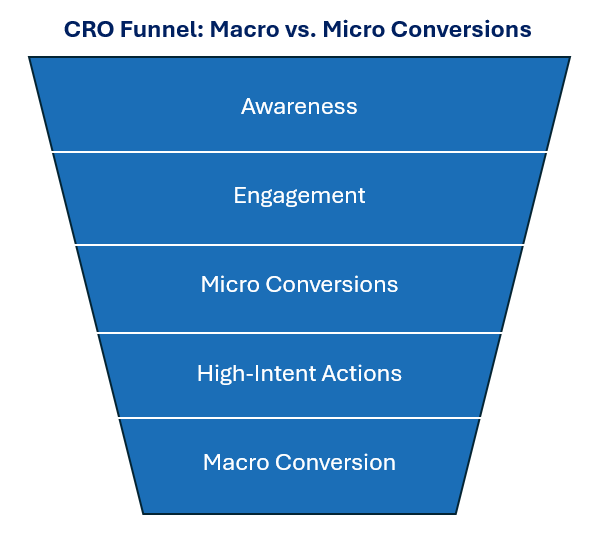
Macro Conversions Define Business Success
Macro conversions are the outcomes that directly support revenue, pipeline, or retention. Completed purchases, paid subscriptions, and qualified lead submissions fall into this category.
They’re essential for reporting and forecasting, but they don’t explain how users got there—or why many never do.
Micro Conversions Reveal What’s Working (and What Isn’t)
Micro conversions capture the smaller actions that signal interest and progress. Viewing key pages, engaging with product content, subscribing to updates, or starting a form all provide valuable insight into intent.
In real-world CRO work, micro conversions often matter more than teams expect. They reveal where users gain confidence, where they hesitate, and where experiences break down. Especially in longer B2B buying cycles, these signals are often the best predictors of future revenue.
Modern CMS and analytics platforms make it easier to track these behaviors and, with AI, use them to personalize content or dynamically adjust journeys.
How to Calculate Conversion Rates Accurately

The formula itself hasn’t changed:
Conversion Rate = (Conversions ÷ Visitors) × 100
What has changed is how teams apply it.
Most organizations calculate conversion rates across multiple dimensions: overall site performance, individual channels, campaigns, pages, and even specific components like forms or CTAs. This layered approach makes it possible to isolate where performance improves—and where it quietly erodes.
With GA4, server-side tracking, and CDP integrations, conversion data has also become more user-centric and less dependent on fragile session-based models. That shift reduces blind spots and makes CRO decisions more defensible.
Why Conversion Rate Optimization Drives Business Growth

More Impact Without More Spend
As acquisition costs rise and organic visibility becomes harder to earn, CRO is often the fastest way to improve results. Increasing the percentage of users who take action can outperform additional traffic investments—especially when traffic quality is already strong.
Even minor improvements compound quickly when applied across high-value funnels.
Making Friction Visible
Conversion data highlights where users struggle, abandon processes, or disengage entirely. Cart abandonment, form drop-off, and low engagement with critical content usually indicate usability or clarity issues—not lack of interest.
When teams pair quantitative data with qualitative insights, such as session recordings or usability testing, the causes become much clearer—and easier to fix.
Enabling Personalization That’s Grounded in Reality
Personalization only works when it’s informed by real behavior. Conversion patterns show which messages resonate, which experiences perform, and which audiences need something different.
Many modern CMS platforms—including Kentico and Optimizely—now support personalization and experimentation directly in the content layer. That reduces dependence on development cycles and enables more continuous optimization.
What Effective CRO Looks Like Today

Research Before Recommendations
The most effective CRO programs start with research, not assumptions. Analytics shows what users do; qualitative tools explain why.
AI-assisted insights are increasingly valuable here, especially for surfacing patterns across large datasets that would be difficult to spot manually.
UX Clarity Beats Clever Persuasion
In practice, clear navigation, logical structure, and straightforward forms usually outperform persuasive tricks. If users can’t quickly understand what you offer or how to move forward, no amount of messaging will make up for it.
This factor becomes even more critical in headless and hybrid environments, such as Xperience by Kentico, where channel consistency directly affects trust and usability.
Fewer Tests, Better Questions
A/B testing is still valuable, but volume alone doesn’t create results. The strongest programs focus on well-defined hypotheses tied to user behavior and business goals.
Modern experimentation platforms support server-side testing and more complex scenarios, making it possible to test changes that affect performance, personalization, and content delivery—not just headlines or button colors.
How CMS and DXP Platforms Impact Conversion Performance

The platform behind your digital experience quietly determines how easy—or difficult—CRO becomes. CMS and DXP platforms that support structured content, flexible delivery, strong integrations, and governance enable faster, more sustainable optimization.
Headless and hybrid architectures, in particular, allow teams to personalize, test, and scale across channels without being constrained by rigid templates. That flexibility is one reason we often choose platforms like Kentico, Optimizely, and WordPress for organizations that take optimization seriously.
When the platform supports experimentation and insight, CRO becomes part of everyday operations—not a special initiative that stalls after launch.
How to Interpret Conversion Rates in Context

There’s no universal benchmark for a “good” conversion rate. Industry, audience intent, traffic sources, and business models all influence what’s realistic.
Broad, high-traffic sites often convert at lower percentages than niche offerings with tightly targeted audiences. What matters more than the absolute number is direction: are conversion rates improving, and are they improving for the audiences that matter most?
As digital ecosystems grow, slight declines in conversion rates are common—and not always a problem—if overall value, pipeline, and customer quality continue to rise.
Why CRO Should Be an Ongoing Capability
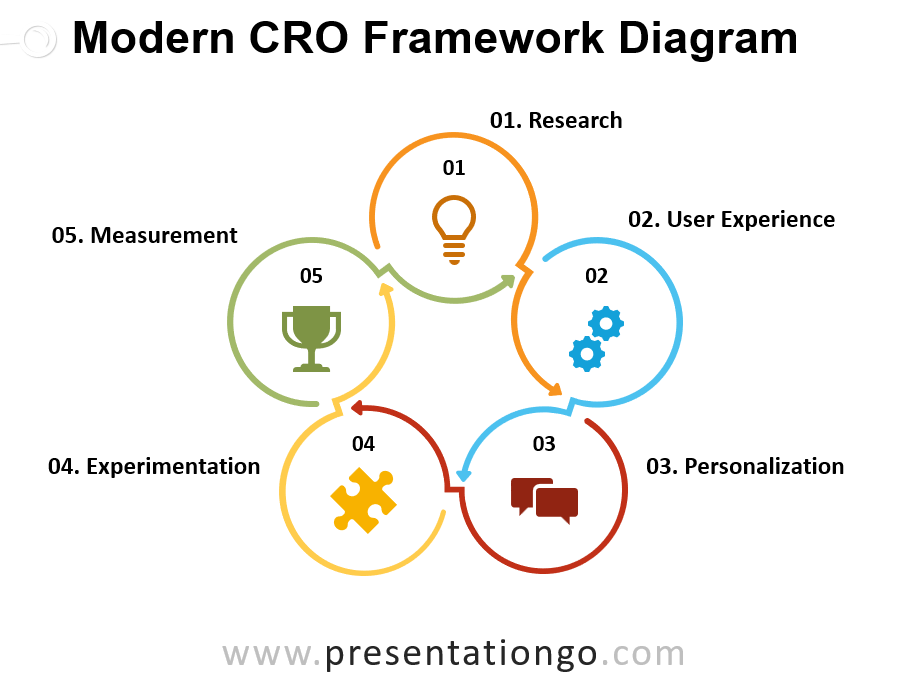
Organizations that see consistent gains treat conversion rate optimization as an ongoing capability. They invest in platforms that support experimentation, align teams around shared metrics, and continuously refine experiences based on real user behavior.
In a landscape shaped by AI, personalization, and multi-channel delivery, CRO is less about chasing percentages and more about building experiences that work—for users and for the business.
Conversion Rate Optimization FAQs
What is a good conversion rate in 2026?
There isn’t a single benchmark that applies to every site. Conversion rates vary widely based on industry, audience intent, and traffic quality. The most meaningful indicator is consistent improvement over time for high-value actions.
How often should conversion rates be reviewed?
Most teams review key conversion metrics monthly, with deeper analysis quarterly. High-traffic or high-value funnels often benefit from more frequent monitoring, especially during active campaigns or experiments.
Does CRO require a headless CMS?
No, but modern CMS platforms that support hybrid or headless architectures often make CRO easier. They allow teams to experiment, personalize, and scale across channels without redesigning entire pages.
Can AI replace CRO strategy?
AI can surface insights and automate parts of the optimization process, but it doesn’t replace strategic thinking. Human judgment is still essential for understanding context, prioritizing changes, and balancing business goals.
Should CRO focus more on micro or macro conversions?
Both matter. Macro conversions measure business outcomes, while micro conversions reveal momentum and intent. Strong CRO programs use both to guide decisions.
About Moonstone Interactive

Moonstone Interactive helps organizations design, build, and optimize digital experiences that perform over time. With deep expertise across enterprise CMS and DXP platforms—including Kentico, Optimizely, and WordPress—Moonstone partners with teams to improve scalability, governance, and measurable results.
To learn more or start a conversation, visit: https://www.msinteractive.com/contact